
The European Media Ownership Monitor (EurOMo) is an EU-funded research project tasked with enhancing transparency around the ownership and control of news media across EU member states.
At the core of EurOMo is the provision of systematic and comparable information on ownership structures, economic control, management, relationships with digital platforms, and relevant media policy frameworks. At the same time, the project highlights where information is missing or incomplete, and the risks this poses to transparency in each country.
“It is important to know who is behind our news provision – citizens should be able to see who ultimately controls the information they consume”, says Ulrika Facht, media analyst at Nordicom and the researcher responsible for collecting data for Sweden.
High transparency and low risk in Sweden
The data collection is based on open and publicly available sources and was carried out by research groups in all 27 EU member states. Research teams have mapped both direct and indirect ownership, cross-market operation, editorial responsibility, funding and revenues, role of algorithmic filtering, and legal framework, among others.
In Sweden, the sample included just over twenty leading news-providing media outlets – ranging from national and local newspaper groups to public service media, TV4, and independent actors such as ETC, Mitt i, Alkompis, and The Local.
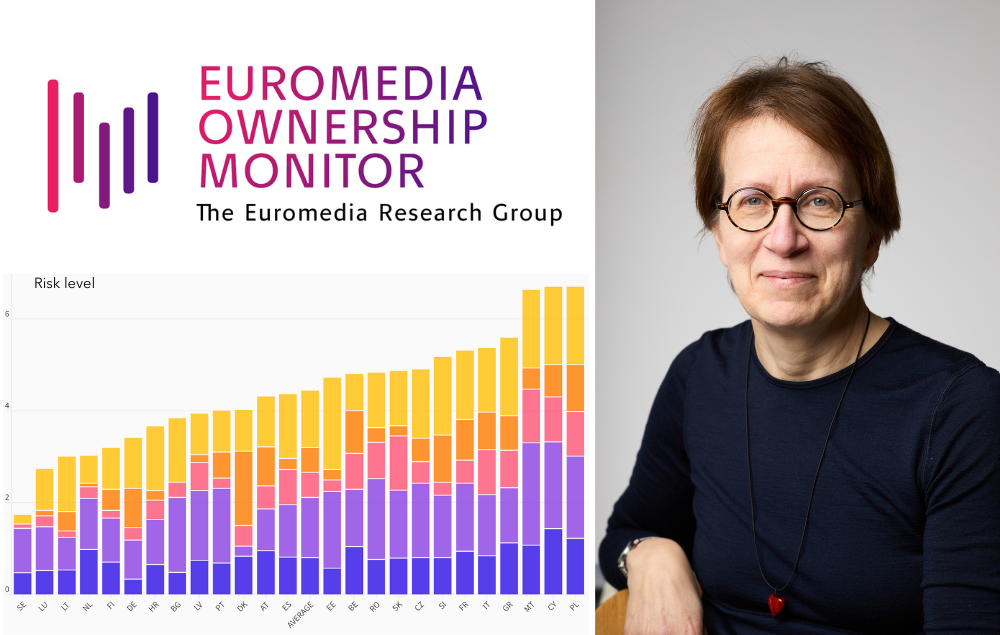
“Transparency among Swedish media companies is strong, and in a comparative EU perspective, the risks related to transparency are low”, says Facht.
The European Media Freedom Act, which entered into force in 2024, also sets requirements for ownership transparency in media, and the mapping shows that Swedish media companies comply with the legislation and are clear in their disclosures.
“In Sweden, the risk related to ownership transparency is assessed as low. This can be linked to the presence of large, well-established actors that are widely known, comply with regulations, and operate within a system of self-regulation that fosters a culture of openness and clarity. Sweden also has a system in which it is the responsible editor-in-chief – not the media owner – who is legally accountable for what is published”, Facht continues.
Nordic similarities – Sweden at the top
Denmark and Finland, like Sweden, display a higher degree of transparency in the ownership and control of news media than the EU average. However, Sweden stands out with the lowest risk of insufficient transparency.
“Major Swedish news outlets are free from direct ties to organisations or political actors. Their owners rarely have interests in other non-media-related industries, nor are there individuals at ownership level residing outside the EU/EEA. This lowers risk levels. That is not to say that there are no links to organisations or politics in Swedish media, but these are limited to outlets with lower reach that do not reach as many users, and they therefore fall outside the scope of this study. The Swedish media market, like the Danish and Finnish markets, is also characterised by a high level of ownership concentration”, says Facht.
More about the project
EurOMo is conducted by a consortium of research groups from universities and independent research organisations across all EU countries. The project is coordinated by the University of Salzburg, and the 2025 edition builds on pilot studies carried out in 2022 and 2023.
All data is presented openly on the project website, media-ownership.eu, where users can search the database, visualise ownership networks, access machine-readable data, and read country-specific reports. EurOMo 2025 thus functions as a shared European tool to identify risks, strengthen accountability, and support evidence-based media policy aimed at greater diversity and democracy.
Read more about the Nordic results at NordMedia Network
Read more about the European Media Ownership Monitor and search the database